

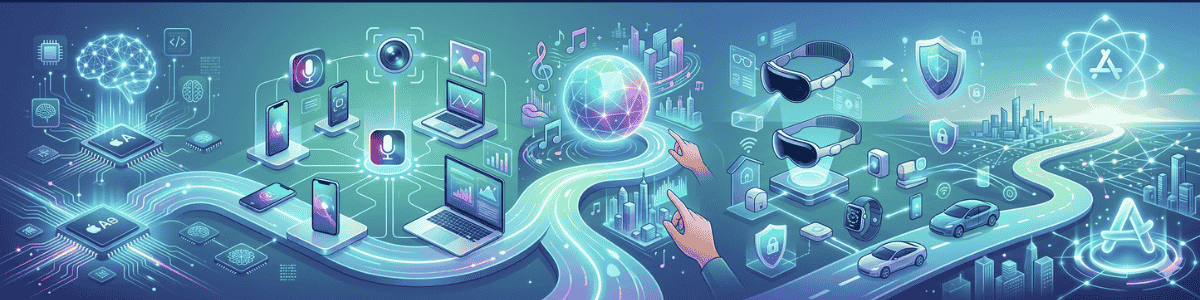
The Apple AI ecosystem roadmap is finally becoming clearer in 2026. After a slower start compared with competitors, Apple is now shifting toward a privacy-first, device-native AI ecosystem powered by Siri, Apple Silicon, wearables, and contextual intelligence across iPhone, Mac, AirPods, and future smart glasses.
The biggest development this month is Apple’s systemwide Siri rebuild, expected to debut at WWDC 2026 as part of a broader Apple Intelligence expansion layer. Recent reports suggest Siri is evolving into a deeply integrated AI agent capable of app control, task execution, and contextual memory across devices.
This roadmap shows Apple’s long-term play: AI delivered through the ecosystem, not just a chatbot app.
1) Siri Becomes the Core AI Operating Layer
The most important part of the Apple AI ecosystem roadmap is Siri’s transformation.
Apple is reportedly testing a standalone Siri experience while also integrating Siri deeper into iOS and macOS system workflows. Instead of simple voice commands, the new version is expected to:
- control apps end-to-end
- access personal context from emails and notes
- summarize Apple News and web content
- switch between voice and chat
- analyze uploaded files and photos
- automate device actions
This turns Siri into a systemwide AI agent, similar to the next generation of enterprise copilots.
For Apple, Siri is becoming the control center of personal intelligence.
2) On-Device AI Powered by Apple Silicon
Apple’s biggest ecosystem advantage remains on-device intelligence.
The roadmap strongly points toward deeper use of:
- Neural Engine acceleration
- local LLM inference
- private context memory
- multimodal processing
- personal workflow suggestions
With the latest M5 chips, Apple is significantly boosting AI compute performance, including up to 4× faster LLM prompt processing on higher-end variants. This creates the hardware base needed for local AI experiences across MacBooks, iPads, and Vision devices.
This strategy aligns with Apple’s long-term privacy positioning: AI should feel personal without exposing personal data.
3) AI Wearables: Smart Glasses, AirPods, and Ambient Context
A major new chapter in the Apple AI ecosystem roadmap is wearables.
Recent reports indicate Apple is actively developing AI smart glasses for a 2027 launch, with cameras, microphones, sensors, and hands-free Siri interaction. Unlike full AR glasses, the near-term focus is on contextual AI wearables that behave like a blend of AirPods and Apple Watch.
Expected capabilities include:
- photo and video capture
- real-time notifications
- contextual assistant responses
- navigation guidance
- ambient voice interaction
- AI memory triggers
This shows Apple’s roadmap is expanding from screens into ambient intelligence layers.
4) Multi-Model AI Strategy Beyond a Single Partner
Another major signal in the Apple AI ecosystem roadmap is model diversification.
Recent reports suggest Apple is moving beyond dependence on a single AI partner and exploring multi-model orchestration, where different models can be selected for reasoning, creativity, coding, or personal assistance tasks.
This roadmap may include:
- Apple’s in-house small language models
- third-party frontier models
- Google Gemini integrations
- secure private cloud compute
- dynamic model routing
The strategic benefit is clear:
- better performance
- lower cost
- stronger privacy governance
- flexibility across devices
- reduced vendor lock-in
This mirrors the broader industry move toward hybrid AI ecosystems.
5) Developer Ecosystem and Xcode AI Expansion
Apple’s AI roadmap is not just for consumers—it is increasingly developer-first.
The latest Xcode 26.3 update introduces stronger AI-assisted coding, including agentic workflows for:
- code generation
- test execution
- bug fixing
- standards compliance
- project orchestration
Apple is also expanding support for external AI coding models directly inside Xcode, making the Mac ecosystem more attractive for AI-native development.
This is critical because the future success of Apple’s AI ecosystem depends on developer adoption and app-level intelligence layers.
6) The Long-Term Roadmap: Personal Intelligence Infrastructure
The real vision behind the Apple AI ecosystem roadmap is bigger than Siri.
Apple appears to be building personal intelligence infrastructure, where:
- iPhone understands habits
- Mac continues work context
- AirPods capture ambient intent
- smart glasses extend awareness
- Siri orchestrates actions
- Apple Silicon keeps it private
This ecosystem-first approach could become Apple’s strongest answer to standalone AI assistants and cloud-first competitors.
People Also Ask
What is Apple’s AI ecosystem roadmap?
Apple’s AI roadmap focuses on Siri as a systemwide AI agent, on-device intelligence, Apple Silicon acceleration, AI wearables, and privacy-first contextual assistance.
Will Apple launch AI smart glasses?
Reports suggest Apple is developing AI smart glasses targeted for 2027 as part of its wearable AI ecosystem.
How is Apple different from other AI companies?
Apple’s strategy emphasizes on-device privacy, ecosystem integration, and hardware-software optimization instead of cloud-only AI tools.
These answer blocks improve AEO + AI Overview visibility.
Final Thoughts
The Apple AI ecosystem roadmap shows a deliberate long-term strategy:
AI embedded into every Apple touchpoint.
From Siri’s rebuild to smart glasses and Apple Silicon, Apple is positioning AI as an ecosystem experience rather than a standalone feature.
For IntentFlowAI, this topic is perfect for:
- Google Discover
- Apple ecosystem traffic
- WWDC trend searches
- AI Overviews
- consumer tech thought leadership
Apple may not be the first mover in AI, but it could become the best ecosystem integrator.
