

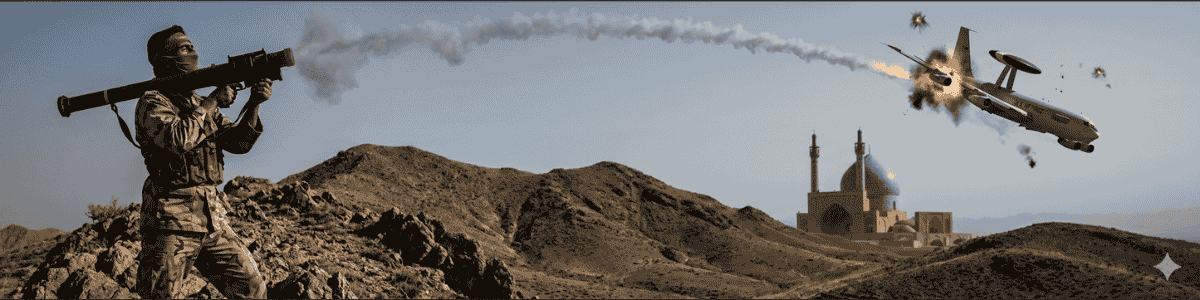
Modern air wars are often imagined as contests between stealth fighters, satellites, drones, and billion-dollar command systems. But in Iran, the most dangerous threat to America’s air superiority may come from something far smaller:
a missile carried on one soldier’s shoulder.
These weapons, known as MANPADS (Man-Portable Air Defense Systems), are compact, mobile, and deadly. Recent battlefield reports suggest that even advanced U.S. aircraft like the F-15E Strike Eagle can be vulnerable when flying over contested Iranian territory.
🚨 Why One Shoulder-Fired Missile Changes Everything
A MANPADS team can be:
- hidden in mountains
- moved in a pickup truck
- deployed within minutes
- almost impossible to track in real time
That changes the risk equation for every U.S. pilot entering Iranian airspace.
Iran’s geography makes this even worse:
- Zagros mountain cover
- desert ridgelines
- tunnel-based mobility
- dispersed mobile units
- short warning windows
A single infantry unit with the right missile can force:
- higher flight altitudes
- reduced low-level strike missions
- less effective close air support
- more standoff missile dependence
- slower rescue operations
This creates strategic friction from a tactical weapon.
✈️ Why the US Air Force Is Vulnerable
The United States dominates conventional air warfare, but combat search-and-rescue and low-altitude strike profiles are always vulnerable to MANPADS.
Recent reporting around a downed U.S. aircraft in Iran highlights exactly this risk. What begins as one shootdown can quickly escalate into:
- pilot ejection
- emergency rescue mission
- helicopters and drones entering hostile airspace
- secondary aircraft losses
- major political fallout
That’s where the cost becomes massive.
One missile worth a few lakhs can threaten:
- fighter jets worth hundreds of crores
- rescue helicopters
- drones
- tanker aircraft support chains
- mission credibility
🛰️ Iran’s Layered Air Defense Makes It Worse
The bigger threat is not just MANPADS alone.
Iran combines:
- shoulder-fired missiles
- mobile SAM launchers
- radar decoys
- underground missile bases
- short-range interceptors
- drone surveillance
This layered defense means U.S. pilots must constantly assume:
the next ridge may hide a launch tube
Even if long-range radar sites are destroyed, small mobile teams remain operational. Iran’s larger air-defense ecosystem still includes systems like Bavar-373 and Khordad variants, which create a multi-layered contested airspace.
💰 The Economics of Air Denial
This is the most dangerous asymmetry in modern warfare:
Cheap missiles vs million-dollar aircraft
A MANPADS launcher may cost a tiny fraction of:
- F-35 sorties
- F-15E strike packages
- electronic warfare escorts
- tanker refueling chains
- CSAR missions
The goal is not necessarily to destroy every aircraft.
Sometimes the real objective is:
make the sky too expensive to use
That alone can slow an air campaign.
🌍 Strategic Impact on the Iran War
If shoulder-fired missiles continue forcing higher losses, the U.S. may shift toward:
- long-range cruise missiles
- naval missile strikes
- standoff bombers
- drone swarms
- cyber targeting
- special forces ISR
But that also reduces:
- persistent presence
- flexible response
- fast close-support
- psychological dominance
In air warfare, perception matters.
The moment pilots no longer feel safe flying lower and closer, air superiority begins to erode.
🧠 Final Analysis
The most dangerous lesson from Iran’s air war is simple:
future conflicts may be decided less by the most advanced jet and more by the most survivable missile team
One soldier.
One launcher.
One heat-seeking missile.
That may be enough to reshape America’s air strategy over Iran.
