

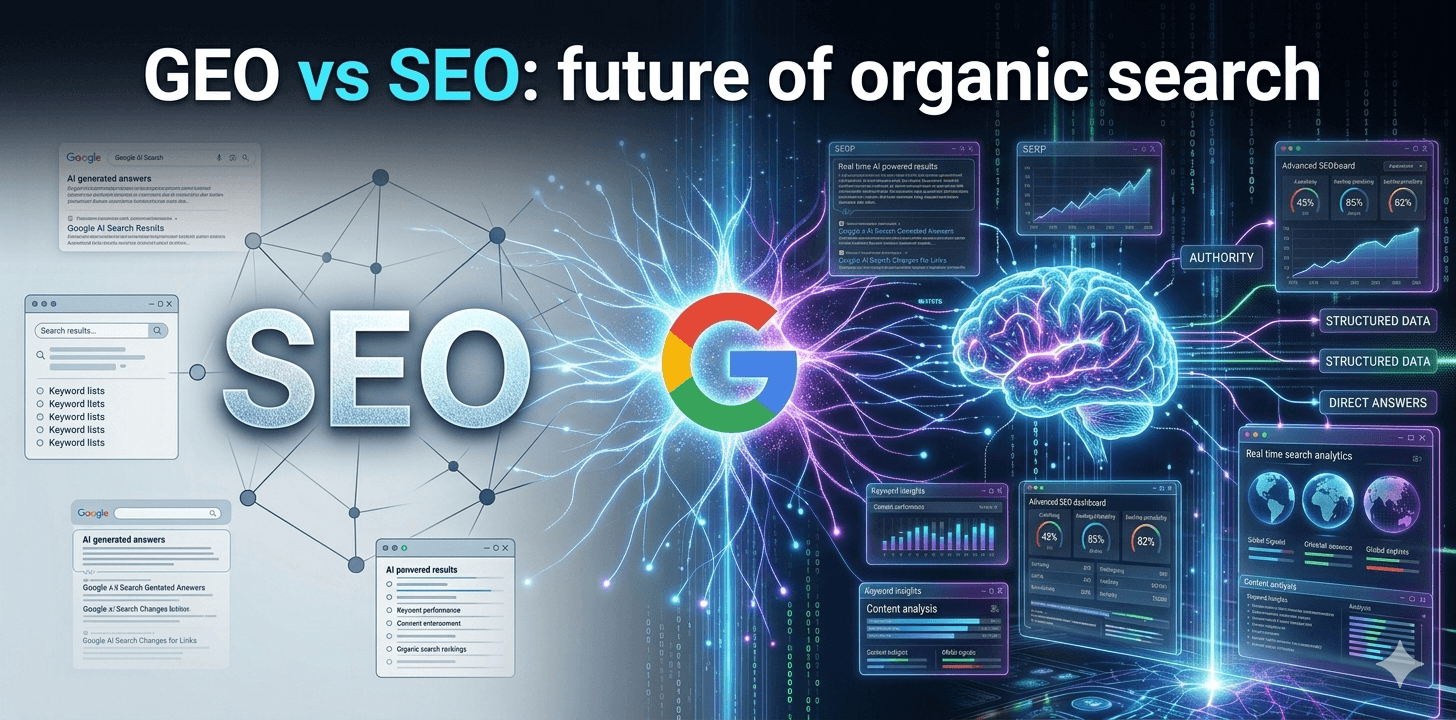
Organic search is no longer limited to Google’s blue links. In 2026, discovery happens across Google AI Overviews, ChatGPT, Perplexity, voice assistants, and social search ecosystems. That shift has created one of the biggest debates in digital marketing: GEO vs SEO.
The truth? It’s not GEO or SEO. The future belongs to SEO + GEO working together. Search behavior is fragmenting, and brands need visibility wherever users ask questions.
What Is SEO?
SEO (Search Engine Optimization) focuses on improving visibility in traditional search engines like Google and Bing.
Core SEO pillars still include:
- keyword research
- technical SEO
- crawlability
- Core Web Vitals
- backlinks
- topical authority
- internal linking
- EEAT signals
SEO’s primary goal is still ranking webpages and driving clicks.
What Is GEO?
GEO (Generative Engine Optimization) is the practice of optimizing content so AI engines can cite, summarize, recommend, and mention your brand inside generated answers.
Instead of just ranking pages, GEO helps your content appear in:
- Google AI Overviews
- ChatGPT answers
- Microsoft Copilot
- Perplexity
- Gemini
- AI voice agents
The new KPI is not only rankings. It is AI citation share and answer visibility.
GEO vs SEO: Key Difference
The biggest difference is the outcome.
SEO outcome
- Higher rankings
- More SERP clicks
- Organic sessions
- Featured snippets
- Discover traffic
GEO outcome
- AI citations
- brand mentions in answers
- recommendation visibility
- zero-click influence
- conversational discovery
In simple words:
SEO helps users find your page. GEO helps AI engines find your expertise.
Why GEO Is the Future of Organic Search
Search Engine Land notes that traditional search volume may decline significantly as users move toward AI-powered answer engines. At the same time, AI interfaces now serve billions of answer experiences monthly.
That means the future of organic search depends on being the trusted source behind the answer, not only the page that ranks.
For publishers like IntentFlowAI, this is a huge opportunity.
AI-first content formats winning in 2026:
- question-led explainers
- comparison articles
- fresh news roundups
- expert POV posts
- listicles with clear summaries
- FAQ hubs
- original research content
The Winning 2026 Strategy: SEO + GEO
The smartest strategy is hybrid visibility optimization.
Keep SEO fundamentals strong
- technical health
- schema
- fast pages
- internal topic clusters
- link authority
- indexation
Add GEO layers
- answer-first paragraphs
- AI-readable summaries
- citation-worthy stats
- entity optimization
- prompt-style headings
- FAQ schema
- expert sources
- freshness updates
Good GEO is built on good SEO foundations. If your site lacks authority, structure, and trust, AI systems are less likely to cite it.
Final Takeaway
The future of organic search is not GEO replacing SEO.
It is SEO evolving into AI visibility strategy.
Brands that combine ranking power with citation optimization will dominate the next phase of discovery. In 2026, winning search means owning both clicks and conversations.
