

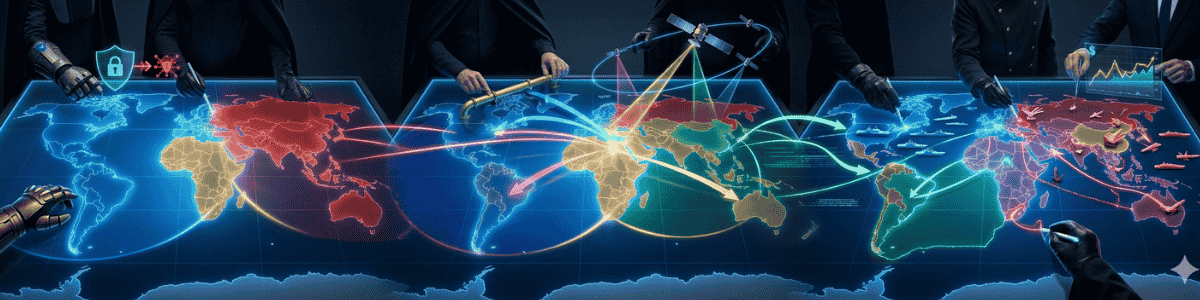
Why Great Power Politics Are Back at the Center
For years, globalization created the belief that economic integration would reduce geopolitical rivalry. Trade, technology, and diplomacy were expected to make borders less important and cooperation more natural.
In 2026, that assumption is breaking down.
Major powers are once again thinking in terms of territory, strategic control, and regional dominance. This is the return of spheres of influence—the idea that powerful nations seek special political, military, and economic authority over specific regions.
This shift is changing everything from energy policy to semiconductor supply chains.
It is also reshaping how businesses think about risk.
The world is becoming less global and more strategically divided.
What Are Spheres of Influence?
A sphere of influence is a region where a major power exercises strong influence over political decisions, economic systems, security arrangements, or infrastructure access.
Historically, this shaped Cold War strategy.
Today, it looks different but follows the same logic.
Examples include:
- Russia’s security posture around Eastern Europe
- China’s strategic reach across the Indo-Pacific
- U.S. influence over defense and technology alliances
- Regional competition across the Middle East and Africa
Influence is no longer defined only by military presence.
It also includes ports, data infrastructure, AI systems, telecom networks, and supply chains.
Power is now both physical and digital.
Ukraine and Europe Changed the Strategic Map
The war in Ukraine accelerated the return of sphere-based thinking.
Europe is no longer treating defense as a secondary issue. NATO expansion, military investment, and energy independence strategies are all responses to a deeper geopolitical reality: geography still matters.
Russia views security through regional control.
Europe views resilience through alliance reinforcement.
This conflict reshaped not only borders, but also long-term investment decisions across energy, manufacturing, and infrastructure.
Business strategy now depends on geopolitical mapping.
The Indo-Pacific Is the New Strategic Center
Nowhere is this shift clearer than the Indo-Pacific.
Competition between the United States and China is defining trade routes, semiconductor policy, maritime security, and technology alliances across the region.
Countries like India, Japan, Australia, Vietnam, and South Korea are navigating increasingly complex strategic choices.
Semiconductor manufacturing, rare earth access, and shipping routes are no longer simple economic issues.
They are strategic assets.
This makes economic policy part of national defense.
Africa and the Middle East Are Strategic Contest Zones
Spheres of influence are also expanding across Africa and the Middle East.
Ports, minerals, energy routes, and digital infrastructure are attracting deeper involvement from China, Russia, the Gulf states, Europe, and the U.S.
This creates overlapping influence systems rather than simple alliances.
The Sahel, Red Sea, and Horn of Africa are becoming critical geopolitical zones because they connect trade, migration, energy, and military positioning.
Local conflicts are increasingly tied to global power competition.
Digital Infrastructure Is the New Territory
Perhaps the biggest change in 2026 is that sovereignty is no longer only about land.
Cloud systems, undersea cables, satellite networks, and AI infrastructure are now strategic territory.
Who controls data flows matters as much as who controls borders.
This is why sovereign cloud, semiconductor policy, and cyber resilience are now core parts of foreign policy.
The future of influence will be decided as much in data centers as in diplomatic summits.
Final Thoughts
The return of spheres of influence shows that history does not disappear.
It evolves.
Great power politics in 2026 is not a return to the past—it is a new version of old strategic logic shaped by technology, infrastructure, and economic dependence.
Countries are not only defending borders.
They are defending systems.
For businesses, this means geopolitical awareness is no longer optional.
Supply chains, market access, investment planning, and digital infrastructure all depend on understanding where power is shifting.
Because in a divided world, strategy starts with geography.
And influence is once again the language of power.
