

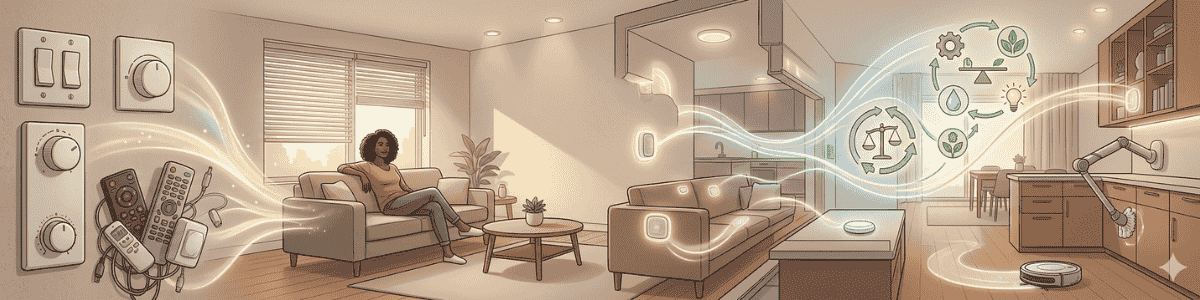
Smart Homes Are Moving Beyond Voice Commands
For years, smart homes promised convenience but delivered something closer to remote control.
Users still had to open apps, issue voice commands, and manually manage routines. Turning on lights with a phone instead of a switch was convenient—but it was not truly intelligent.
In 2026, that is changing.
Smart homes are finally becoming autonomous.
Instead of waiting for instructions, modern systems are learning behavior, predicting needs, and adjusting environments automatically. This shift is powered by AI, ambient intelligence, and connected ecosystems that work quietly in the background.
The smartest home is no longer the one with the most devices.
It is the one you barely have to think about.
What Makes a Home Truly Autonomous?
An autonomous smart home does more than respond.
It anticipates.
These systems can:
- Adjust lighting based on time, mood, and activity
- Optimize temperature using occupancy and weather patterns
- Manage energy use for lower cost and efficiency
- Monitor security through behavioral awareness
- Reorder household essentials automatically
- Coordinate appliances for daily routines
- Support elder care and health monitoring
The goal is not automation for novelty.
It is frictionless living.
Technology becomes part of the environment rather than another task to manage.
AI Is Turning Homes Into Predictive Systems
The biggest upgrade is predictive intelligence.
Instead of setting routines manually, AI studies patterns.
For example:
Your home may lower lighting and reduce noise when it detects stress signals from your wearable. It may prepare the workspace environment before your first meeting or adjust sleep settings based on recovery data.
This creates a home that feels responsive rather than programmable.
Companies like Amazon, Google, Apple, and Samsung are building ecosystems designed around this model.
The future is not smarter commands.
It is fewer commands.
Energy Efficiency Is a Major Driver
Autonomous homes are also becoming important for sustainability.
AI can optimize energy consumption by balancing appliances, adjusting climate systems, and integrating solar storage or electric vehicle charging intelligently.
This matters more in 2026 as energy costs rise and households prioritize long-term efficiency.
A home that manages consumption automatically saves both money and environmental impact.
Smart living is becoming resource management.
Efficiency is now part of comfort.
Health and Wellness Are Entering the Home System
Another major trend is wellness integration.
Homes are starting to respond to human well-being, not just convenience.
This includes:
- Air quality monitoring
- Sleep-focused lighting and sound environments
- Indoor climate optimization
- Elder care support systems
- Emergency health detection
- Wellness recommendations linked to wearable data
The house becomes part of personal health infrastructure.
It supports daily recovery, focus, and safety without requiring constant attention.
This makes smart homes far more valuable than entertainment systems alone.
Privacy Will Decide Adoption
As homes become more intelligent, privacy becomes critical.
Users want to know:
Who controls the data?
What is processed locally?
Who has access to routines, habits, and personal health signals?
Trust will define the winners.
Consumers are becoming more selective about ecosystems that respect privacy and transparency.
An autonomous home must feel safe, not invasive.
Without trust, convenience loses value.
Final Thoughts
Smart homes in 2026 are finally delivering on the original promise of intelligence.
They are moving beyond voice assistants and app-based routines into something far more meaningful—environments that understand, adapt, and support daily life automatically.
The future of home technology is not more screens or more settings.
It is calm.
It is invisible systems that reduce decisions, improve wellness, and make everyday life smoother without demanding attention.
Manual control is not disappearing completely.
But it is no longer the center.
Because the best technology is the kind you stop noticing.
And that future has already moved in.
