

Why Retro Tech Is Making a Serious Comeback
In a world dominated by AI, smart homes, and invisible computing, something unexpected is happening in 2026—people are falling in love with weird gadgets again.
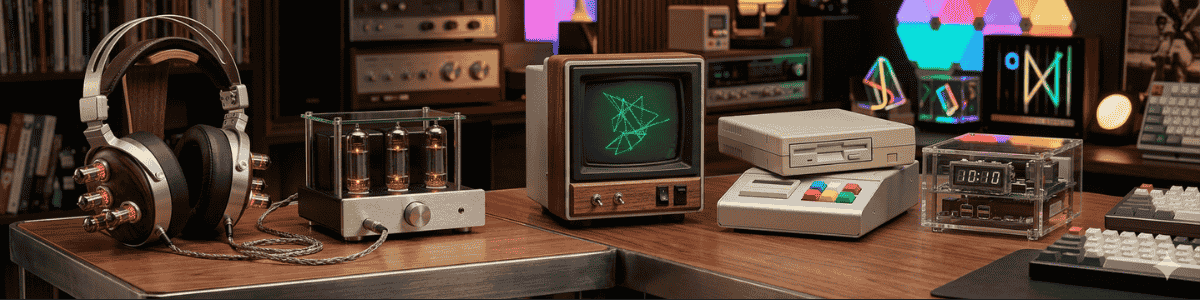
Vacuum tube headphones, retro mini PCs, mechanical keyboards, cassette-inspired audio players, and handheld gaming devices are returning to desks, homes, and creator setups.
This is not just nostalgia.
It is a shift in how people relate to technology.
Users are moving away from disposable, identical devices and choosing gadgets that feel personal, tactile, and emotionally memorable.
The result is a full-scale retro tech renaissance.
What Is Driving the Weird Gadget Revival?
Modern devices are powerful, but they often feel invisible and interchangeable.
The same flat screens, minimal designs, and cloud-first experiences dominate nearly every product.
Retro gadgets offer the opposite.
They provide:
- Physical interaction and tactile feedback
- Unique industrial design
- Repairability and ownership
- Emotional connection and nostalgia
- Creative identity and personalization
People want technology that feels like an object—not just a service.
This is why niche hardware communities are growing rapidly across creators, gamers, music lovers, and professionals.
Vacuum Tube Headphones Are Becoming Status Devices
One of the strangest examples is the return of vacuum tube audio gear.
Audiophiles are embracing tube amplifiers, hybrid headphones, and retro-inspired listening setups because they value warmth, analog character, and intentional listening.
Brands like FiiO and boutique headphone manufacturers are helping modernize this space by blending classic sound signatures with portable digital convenience.
For many users, music is becoming less about streaming speed and more about listening as an experience.
The device becomes part of the ritual.
Retro Mini PCs Are Winning the Desk Setup Game
Mini PCs with vintage-inspired design are also growing in popularity.
Compact systems inspired by old-school desktop computing offer a mix of nostalgia and modern performance. They appeal to developers, remote workers, and creators who want function without generic aesthetics.
Some users are restoring classic systems, while others are buying modern mini PCs styled like 1980s or 1990s hardware.
This trend combines:
- Compact productivity
- Home lab experimentation
- Local-first computing
- Offline creativity
- Desk setup personalization
The machine becomes part of identity, not just utility.
Mechanical Culture Is Replacing Passive Consumption
Another reason for this trend is the rise of mechanical culture.
People want to build, modify, and understand their devices.
Mechanical keyboards, modular PCs, handheld emulators, and analog-inspired tools create participation instead of passive usage.
This reflects a deeper cultural shift.
Users are tired of sealed ecosystems and subscription dependence. They want products they can touch, tune, and keep.
Ownership feels valuable again.
Retro tech supports that mindset.
AI and Retro Tech Are Surprisingly Compatible
Interestingly, this renaissance is not anti-AI.
Many users combine cutting-edge software with old-school hardware values.
A creator may use AI tools on a retro-style keyboard. A developer may run local AI models on a compact home server with a vintage-inspired setup.
The future is not always sleek and invisible.
Sometimes it looks like glowing tubes and tiny beige computers.
Technology is becoming more personal, not less advanced.
Final Thoughts
The weird gadget renaissance shows that innovation is not always about the newest feature.
Sometimes it is about how technology makes people feel.
Vacuum tube headphones, retro mini PCs, and tactile devices are thriving because they offer presence in a world of digital abstraction.
They turn technology into experience.
In 2026, the best gadget is not always the smartest one.
It is the one you actually enjoy using.
That is why retro tech is not a passing trend.
It is a reminder that function and feeling can still exist in the same machine.
