

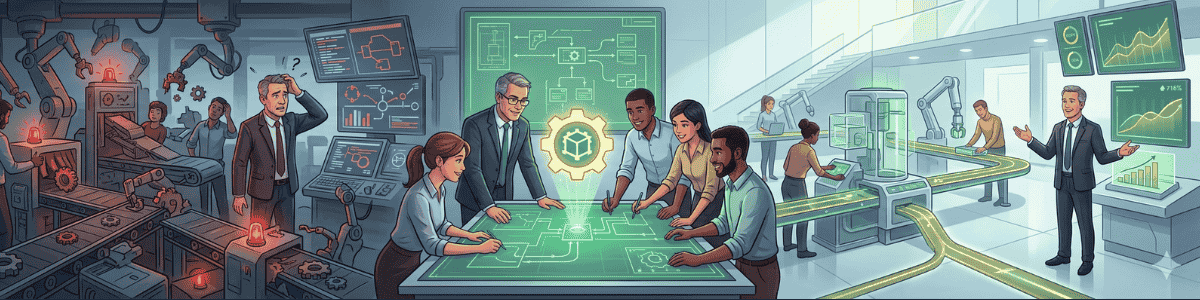
Why Automation Alone Is Failing
For years, the promise sounded simple: automate more, grow faster.
Businesses rushed to deploy AI tools, workflow software, chatbots, and robotic process automation across every department. The assumption was clear—more automation would automatically create more efficiency.
But in 2026, many leaders are learning a painful truth:
Automation does not fix broken systems. It scales them.
Instead of reducing friction, many companies ended up automating confusion, duplication, and bad decision-making.
This is why the smartest tech leaders are changing direction.
They are no longer asking, “What can we automate?”
They are asking, “What should be redesigned first?”
Bad Processes Become Faster Problems
Automation works best when the underlying workflow is already strong.
If approvals are unclear, ownership is missing, or teams operate in silos, automation simply makes those failures happen faster.
A poorly designed sales process with automation becomes a faster broken sales process.
An unclear customer support flow with AI becomes a more efficient way to frustrate customers.
According to McKinsey & Company, organizations that align workflow redesign with AI adoption consistently outperform those that deploy tools without operational restructuring.
Technology is not the strategy.
System design is.
Process Redesign Comes Before AI
The strongest companies in 2026 are auditing operations before buying tools.
They start by asking:
- Where does work actually slow down?
- Which decisions create the most friction?
- What dependencies cause delays?
- Where is manual work truly necessary?
- What should be eliminated instead of automated?
Sometimes the best automation decision is deleting the step entirely.
This mindset saves time, budget, and organizational trust.
AI becomes valuable only after clarity exists.
Leaders Want Outcomes, Not More Dashboards
Executives are tired of transformation projects that produce presentations instead of results.
They want:
- Faster revenue cycles
- Lower operating costs
- Stronger customer retention
- Better employee productivity
- Clearer accountability
This means teams must connect automation directly to business outcomes.
A chatbot is not success.
Reduced support cost is success.
A workflow platform is not success.
Shorter procurement cycles are success.
Technology must be measured by business impact.
Human Workflow Still Matters Most
Many organizations assumed automation would reduce the importance of people.
The opposite is happening.
As routine tasks become automated, human work becomes more strategic. Teams must handle judgment, trust, negotiation, and cross-functional decision-making—areas where poor process design creates the biggest failures.
This is why redesign is often more cultural than technical.
It requires leadership alignment, role clarity, and operational discipline.
Software cannot replace accountability.
Redesign Creates Scalable Infrastructure
The companies winning in 2026 treat operations like infrastructure.
They redesign systems so that growth becomes easier, not more chaotic.
This includes:
- CRM and ERP alignment
- Approval architecture
- Data governance
- Ownership mapping
- Customer journey simplification
- AI governance and compliance frameworks
These are not exciting launch announcements.
They are competitive advantages.
Strong infrastructure makes automation sustainable.
Final Thoughts
The lesson of 2026 is not that automation failed.
It is that automation was expected to solve problems it was never designed to fix.
Tech leaders are learning that transformation begins with redesign, not software procurement.
The goal is not to automate more.
It is to build systems that deserve automation.
Because speed without structure creates expensive failure.
But redesign creates something far more valuable:
clarity, resilience, and scalable growth.
The future belongs to businesses that fix the process before they accelerate it.
That is where real transformation begins.
