

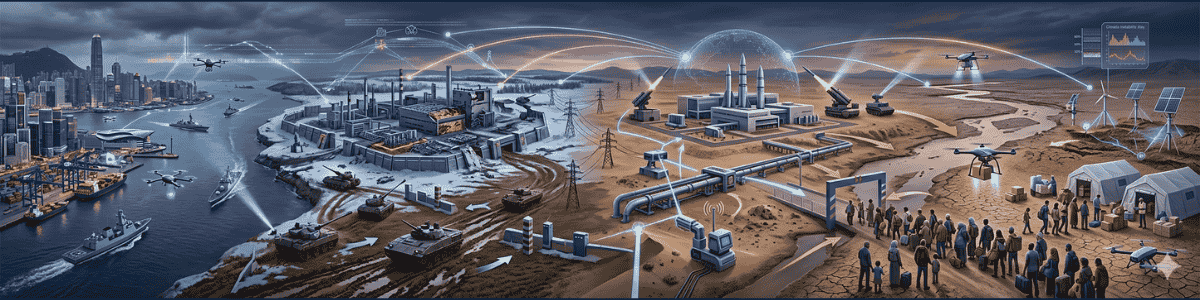
Why 2026 Is Defined by Overlapping Global Crises
The world in 2026 is not facing one crisis—it is facing many at once.
Geopolitical conflict, energy disruption, economic instability, supply chain breakdowns, and climate shocks are no longer separate headlines. They are interconnected pressure points creating what experts call a polycrisis.
This makes 2026 one of the most strategically important years of the decade.
The question is no longer whether disruption will happen.
It is where the next shock will trigger the biggest chain reaction.
According to the World Economic Forum Global Risks Report 2026, geopolitical shocks, climate instability, rapid technological change, and societal fragmentation are converging into a new era of systemic uncertainty.
The Middle East Energy Shock
One of the biggest flashpoints remains the Middle East.
The escalation involving Iran, U.S.-Israel military action, and the disruption around the Strait of Hormuz has already created serious energy market instability. Since this route handles a major share of global oil transport, even temporary disruption creates global inflation pressure.
The International Monetary Fund warned that the conflict has slowed global economic momentum and pushed its 2026 global growth forecast down to 3.1%, while inflation risks continue rising.
Asia is particularly vulnerable because of its dependence on imported fuel from the region.
This is not just a regional conflict.
It is a global economic trigger.
Ukraine, Europe, and Security Fatigue
The war in Ukraine continues to reshape Europe’s economic and defense priorities.
Military spending remains elevated, supply chains remain fragile, and energy security is still central to European policy. At the same time, NATO alignment, sanctions pressure, and defense investment are changing long-term business decisions across the region.
Analysts increasingly connect Ukraine, the Western Balkans, and the Israel-Iran axis as mutually reinforcing instability zones rather than isolated crises.
This creates strategic fatigue across governments and investors alike.
Climate Risk Is Becoming an Economic Risk
Climate events are now boardroom risks, not just environmental concerns.
Floods, droughts, heatwaves, and food insecurity are directly affecting supply chains, insurance costs, and migration patterns. Water stress and agricultural disruption are increasing political instability in already fragile economies.
The World Economic Forum highlights climate instability as one of the top structural risks shaping the next decade.
For businesses, climate resilience is no longer optional.
It is financial strategy.
Debt Pressure and Emerging Market Fragility
Developing economies are facing another major stress point.
Countries like Zambia, Sri Lanka, and Nigeria are dealing with repeated cycles of debt pressure, inflation, food insecurity, and weak recovery from previous shocks.
At the 2026 IMF–World Bank meetings, leaders warned that many nations remain trapped in “permacrisis,” where each new global shock resets recovery efforts.
Without stronger structural financing models, instability in emerging markets could become the next major global economic spillover.
Strategic Chokepoints Are the Hidden Risk
Global trade depends on narrow geographic chokepoints.
The Strait of Hormuz and Bab el-Mandeb are now major examples. Disruption in either can affect shipping costs, fuel prices, and supply availability worldwide.
With Hormuz under pressure, Bab el-Mandeb has become even more critical for energy and maritime trade flows.
In 2026, geography itself has become a business risk.
Final Thoughts
Flashpoints 2026 is not about predicting one major crisis.
It is about understanding how multiple crises overlap.
War drives inflation.
Energy disruption drives food insecurity.
Climate shocks drive migration.
Debt stress drives political instability.
Each problem strengthens the next.
The leaders who succeed in 2026 will not be those who react fastest.
They will be those who think systemically.
Because in a polycrisis world, strategy is no longer about isolated decisions.
It is about resilience across the entire system.
