

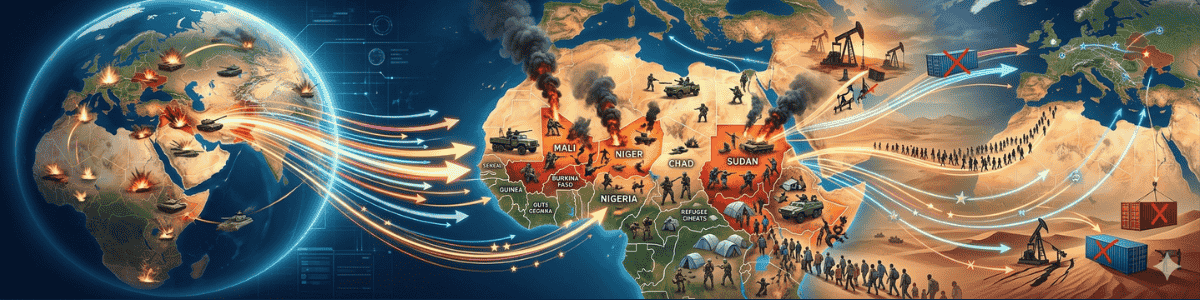
Why Global Conflict Is Moving Beyond Traditional Hotspots
For decades, global security discussions focused on regions like Eastern Europe, the Middle East, and East Asia. However, in 2026, a major shift is happening.
The world’s most dangerous instability is increasingly concentrated in places that were once treated as “secondary theaters”—the Sahel, Sudan, the Horn of Africa, and parts of Central Africa.
These regions are no longer peripheral conflicts.
They are becoming central to global security, migration patterns, food systems, and international economic stability.
Understanding this shift is critical for governments, businesses, and institutions planning for the future.
The Sahel: The New Epicenter of Instability
The Sahel region—stretching across countries like Mali, Burkina Faso, Niger, and Chad—has become one of the fastest-growing conflict zones in the world.
Military coups, extremist violence, resource scarcity, and weakened governance have created a dangerous cycle of instability. Terror groups linked to al-Qaeda and ISIS continue expanding influence across fragile borders.
According to the United Nations, violence in the Sahel has displaced millions and triggered one of the world’s fastest-growing humanitarian crises.
Food insecurity, climate pressure, and state fragility are now reinforcing each other.
This is not just a regional crisis.
It is a long-term structural threat to African and global stability.
Sudan: A Civil War With Global Consequences
Sudan remains one of the most urgent humanitarian disasters of 2026.
The ongoing conflict between the Sudanese Armed Forces and the Rapid Support Forces has devastated infrastructure, displaced millions, and collapsed essential services.
But Sudan’s crisis extends beyond national borders.
It affects Red Sea trade routes, regional migration into Egypt and East Africa, and agricultural supply chains that influence food security across Africa and the Middle East.
The United Nations and humanitarian agencies continue to warn that Sudan risks becoming one of the largest displacement crises of the decade.
Its instability is not isolated—it is regionalized.
Why Climate Change Is Fueling Conflict
One of the most overlooked drivers of conflict in these regions is climate stress.
Droughts, water scarcity, desertification, and agricultural collapse are increasing competition over land and resources. This creates local violence that quickly becomes political instability.
In the Sahel especially, climate change acts as a threat multiplier.
Farmers, herders, and displaced populations are pushed into conflict over shrinking resources, while weak governments struggle to respond.
Climate risk is now a national security issue.
Great Power Competition Is Expanding
Another major shift is the involvement of external powers.
Russia, China, Turkey, Gulf states, and Western governments are all increasing influence across Africa through military agreements, infrastructure projects, and strategic resource access.
This creates a more complex geopolitical landscape.
Conflict zones are no longer isolated local crises—they are becoming arenas for global power competition.
Control over ports, minerals, rare earth resources, and trade routes makes these regions strategically important far beyond their borders.
Migration and Economic Spillover Effects
Conflict in the Sahel and Sudan directly shapes migration flows toward North Africa and Europe.
This affects border policy, labor markets, political stability, and international aid systems.
At the same time, disruptions in agriculture, mining, and logistics create wider economic consequences.
Supply chain resilience is increasingly linked to security outcomes in regions many companies previously ignored.
What happens in Sudan does not stay in Sudan.
It affects global systems.
Final Thoughts
The geography of conflict is changing.
The Sahel, Sudan, and neighboring regions are becoming defining security zones of the modern world. These are not distant humanitarian stories—they are strategic realities shaping trade, migration, diplomacy, and economic planning.
The biggest mistake leaders can make in 2026 is treating these conflicts as isolated crises.
They are connected to global markets, climate strategy, and geopolitical competition.
The future of international stability will not be determined only in Washington, Brussels, or Beijing.
It will also be shaped in Khartoum, Bamako, and across the fragile belt of the Sahel.
Understanding that shift is the first step toward responding effectively.
